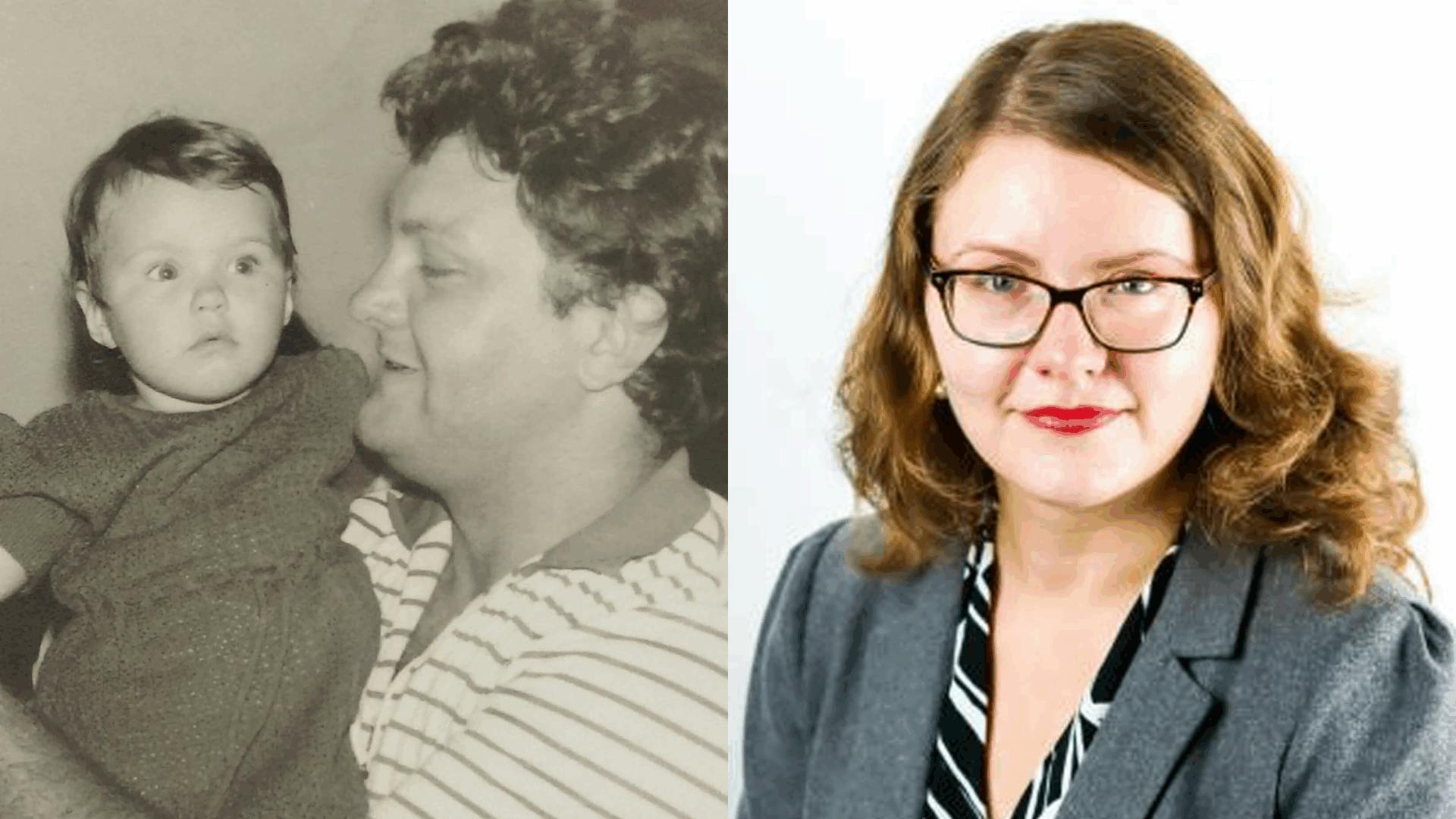
Growing up in Romania
From a childhood under dictatorship to teaching the moral foundations of freedom, Paula Ganga’s journey traces what it means to keep ideas alive.
In late-1980s Romania, Paula’s evenings followed the same ritual. At 8 PM, her apartment block fell silent as families tuned in to the two-hour state broadcast. It was mostly crude propaganda: the Leader and his wife touring factories, inspecting harvests, and proclaiming yet another year of record productivity.

What Paula waited for was the five minutes of children's programming, usually a Soviet cartoon where a dutiful rabbit outsmarted a slouching wolf with a cigarette in his mouth. Then, one night, the black-and-white TV erupted with movement and music unlike anything she had ever known.
It was Snow White and the Seven Dwarfs.
Paula sat transfixed. “What on earth is this? How can this exist in the same world as the Soviet cartoon?”

Embracing Freedom
That jolt of freedom stayed with Paula through the difficult years of Romania’s transition to democracy. Political reforms proved elusive—many communist officials simply rebranded themselves as democrats—and economic reforms were slow and painful. Factories closed. Her mother cycled through uncertain work.
Against that background, it was in the realm of ideas that freedom came most vividly to life.
By the early 2000s, Paula’s Romanian professors were finally free to teach works long banned under communism: Hayek, Schumpeter, Adam Smith, and others. They saw it as their mission to open young minds to the widest range of thought possible so that the next generation would have what it takes to live freely.
For Paula, the question became what makes freedom hold—and why it so often slips away. She looked for answers in development, political economy, and political science. After completing her undergraduate studies in Romania and a master’s degree at Oxford, those questions brought her to the United States in 2010 to pursue a doctorate at Georgetown.
At Georgetown, Paula joined her classmates in the race to build technical skills in statistics, data analysis, and career preparation. She took all the statistics courses. She was even a star student. After all, she wanted to be employable.

But something from Romania stayed with her. The ideas her professors had once hidden in manila folders were now stacked openly on library shelves in America—but few cared to read them.
Dissertations that were supposed to crown years of thought and argument had become technical papers chasing marginal statistical gains. Somehow, professionalism meant not thinking too much—or too deeply—about the ideas that had made freedom possible to begin with.
The study of means and methods had overtaken the study of goals and ends.
Methods and statistics come before philosophy, if philosophy is studied at all.
So when she found a community that still treated ideas as living things, it felt like proof that the seriousness she once felt in Romania could also exist here. She found it an IHS event at George Mason University—just a short walk from her apartment.
IHS President Emily Chamlee-Wright led the discussion on property rights, drawing out connections between classical liberal principles and contemporary challenges with exceptional warmth and clarity. Even though the room lacked windows, the ideas felt like a breath of fresh air.
Paula was immediately hooked. What began as one evening quickly grew into a lasting relationship. IHS became a steady companion in her academic journey—providing community, funding for research, and opportunities for growth at every stage.
Embodying the Tradition
Today, Paula carries that passion for ideas into her own classroom. For her, classical liberal education is not about memorizing doctrines but about cultivating debate, skepticism, and context. She reminds her students that ideas and policies rarely translate neatly from theory into practice. She tells them to challenge everything—even policies passed in Adam Smith's name that he might not recognize. "Classical liberal ideas don't automatically translate into great policy," she reminds them. "Absolutely criticize—especially if you know it was applied in your country and it didn't work out."
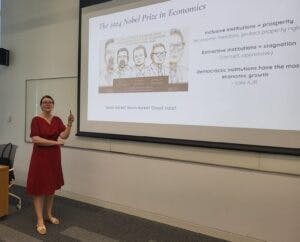
Her students quickly learn that she does not present classical liberal thought as a rigid framework. What matters, she insists, is that they are challenging themselves—not simply taking her word for it.
Drawing on her study of Central and Eastern Europe, Paula also reminds her students that vigilance against authoritarianism never ends. Economic freedom without political freedom is hollow. Classical liberalism, she insists, is not only about markets, but also about the freedom to dissent, to oppose, and to debate.
What she works to pass on to the next generation is straightforward: the conviction that ideas matter most when they're tested, questioned, and lived—not just studied from a distance.
In that sense, her teaching carries forward the same shock of recognition she felt as a child watching Snow White—the sudden realization that something freer, richer, and more human could exist in the same world as its opposite.
Paula Ganga is an assistant professor of political economy at Duke Kunshan University and a visiting fellow at Stanford University.
By supporting IHS, you invest in scholars at a formative stage in their careers—not only with crucial financial support, but also with inspiration and connections to other like-minded and driven intellectual collaborators that they can’t find anywhere else.