



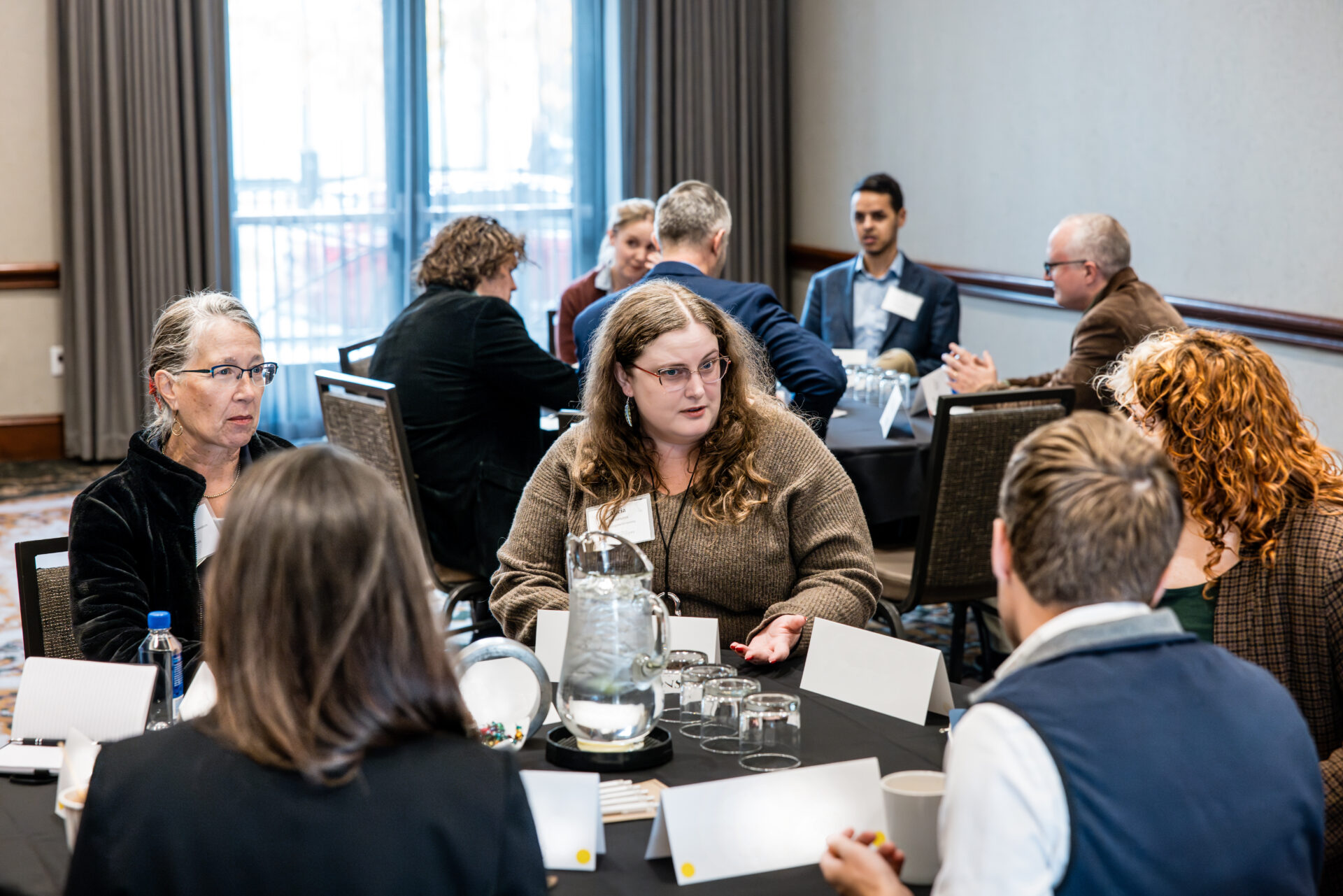
In her class, Alicia Plemmons kept noticing something her peers wouldn’t acknowledge. Every policy failure triggered the same reflex: add more rules, and more subsidies. But what if the system itself is the problem?
This was not an abstract question for Alicia. When she was thirteen, her mother, a veteran PE teacher with nearly two decades of experience, lost years of her career to a state line. Crossing one hour south from North Carolina to South Carolina meant starting over: two years of classes, part-time work, and a fraction of her former pay.
Years later, her sister spent months trapped in a maze of referrals, insurance limits, and psychiatrist waitlists while seeking treatment for a serious mental health condition. By the time help arrived, she’d been involuntarily confined and required intensive care that could have been prevented with earlier access to medication.

Alicia thought she was the only one asking these questions. Then, at a 2016 conference, she stopped at an IHS booth because the mugs looked cool. Within fifteen minutes of talking with IHS’s Nigel Ashford, she realized her mistake.
On her application to an IHS summer colloquium, she wrote, “I don’t know if I believe what y’all believe, but I want to hear you out.”
At another IHS event a year later, she heard the question that would define her career: Why does it take more hours to become a hair braider than a police officer? The session featured stories of people blocked from work by arbitrary licensing rules, the exact system failures she’d witnessed in her own family’s experiences.
Through IHS conferences, networks, and collaborators, she saw the gap: policymakers needed evidence, but the data sat behind paywalls only elite institutions could afford. She decided to do something about that.
Building a Data Tip Line for Policymakers
With IHS’s support, Alicia founded the Health Regulation Incubator at West Virginia University, a project that functions like a data tip line for policymakers. “How do we get resources that typically live in the Ivory Tower to the groups on the ground?” she asked.
“How do we get resources that typically live in the Ivory Tower to the groups on the ground?”
IHS funding enabled her team to purchase expensive datasets that usually sit behind paywalls, train students and postdocs to analyze them, and provide quick, evidence-based answers to the questions legislators and think tanks actually ask.
For decades, legislators called Ivy League institutions first. Now, they call West Virginia University.
Alicia is careful to emphasize that the incubator doesn’t advocate for policies. As a public university researcher, her mission is educational outreach. But her team’s evidence often reshapes the debate: What happened when other states tried this? What worked? What didn’t?
When Decision Windows Open
In Idaho and Montana, her team’s research supported reforms that allow pharmacists to dispense time-critical medications like insulin and inhalers without an emergency room visit. On average, each pharmacist now helps about three people per year avoid a medical crisis, preventing both emergency room visits and potential medical bankruptcy.
In Wisconsin, Governor Tony Evers signed legislation in spring 2025 allowing nurse practitioners to practice independently—a bill he had vetoed twice before. Alicia’s team supplied testimony, analysis, and public communications addressing his concerns about patient safety. The result is that more than one million rural residents now have better access to primary care and mental health services.
In Pennsylvania and New Jersey, her data informed legislative hearings on nurse practitioner reforms. Evidence shows 11–15% reductions in suicide rates when patients can access medication without months-long psychiatrist waitlists, the kind that once trapped her sister.
The incubator project is now reshaping career paths. PhD students who once planned government jobs are learning a different model. Alicia says, “I try to show them while we still have them here, before they go off to their government dreams: ‘there’s another way you could do this.'” Some now staff agencies and think tanks nationwide. Others are building similar incubators at universities across the country.
The Resistance
Opposition is constant. Professional associations, especially the American Medical Association, frequently resist reforms that expand health care access, even when data shows safety and improved outcomes.
“At the end of the day, it’s always about paychecks,” Alicia says. “We can show that nurse practitioners reduce diabetic foot amputations in rural areas, but if that costs one physician 3% of income, the resistance is fierce.”

Changing the System
“IHS always puts me in rooms with people asking really difficult questions,” Alicia reflects. “It challenged me to think harder about my research and got me more excited to do the work I do.”
“IHS always puts me in rooms with people asking really difficult questions.”
IHS didn’t just fund one scholar; it built the infrastructure that moves ideas when decision windows open. Seed funding for the incubator. Networks that connected her team with policymakers who needed the data. Training programs that helped replicate the model nationwide.
“It really let us go from helping three states in the Northeast to helping all 50 states,” she says. “It’s a collaborative experience among the network IHS provides, rather than competition.”
Alicia’s story embodies the question that launched her career: What if we’re solving the wrong problem?
Her mother couldn’t cross a state line to keep teaching. Her sister couldn’t get the medication she was asking for. None of these were personal failures; they were failures of design.
And design can be changed. When evidence reaches decision-makers, when scholars are ready to respond, and when institutions like IHS make it possible for ideas to move at the speed of policy, the system itself can start to work for the people inside it.
By supporting IHS, you invest in scholars like Alicia at a formative stage in their careers—not only with crucial financial support, but also with inspiration and connections to other like-minded and driven intellectual collaborators that they can’t find anywhere else.


